 Streetmodo
Best of the Ancient Agora of Athens: Temples, Civic Life and the Stoa of Attalos
Updated · Streetmodo
The Ancient Agora can seem harder to read than the Acropolis: one has a skyline of temples, while the other spreads its stories across paths, foundations and reconstructed spaces. That is precisely its appeal. Here, public business, worship and everyday movement occupied the same landscape. These seven highlights give your walk a structure, pairing the obvious landmarks with the smaller remains that explain how the civic center worked.
Explore with the Agora of Athens Audio Tour on the App Store.
The Panathenaic Way: find the route through the whole site
Start by identifying the Panathenaic Way on the site plan and comparing it with the ground in front of you. This processional route provides a useful line through a space that otherwise feels like a scatter of individual monuments. Look toward the Acropolis to understand where a major ceremonial journey was heading.
Use the road as an orientation device throughout your visit. Each time you move to a new building, ask whether you have crossed it or remained on the same side. That simple habit makes the Agora easier to remember as a connected place.
The Temple of Hephaestus: the landmark above the ruins
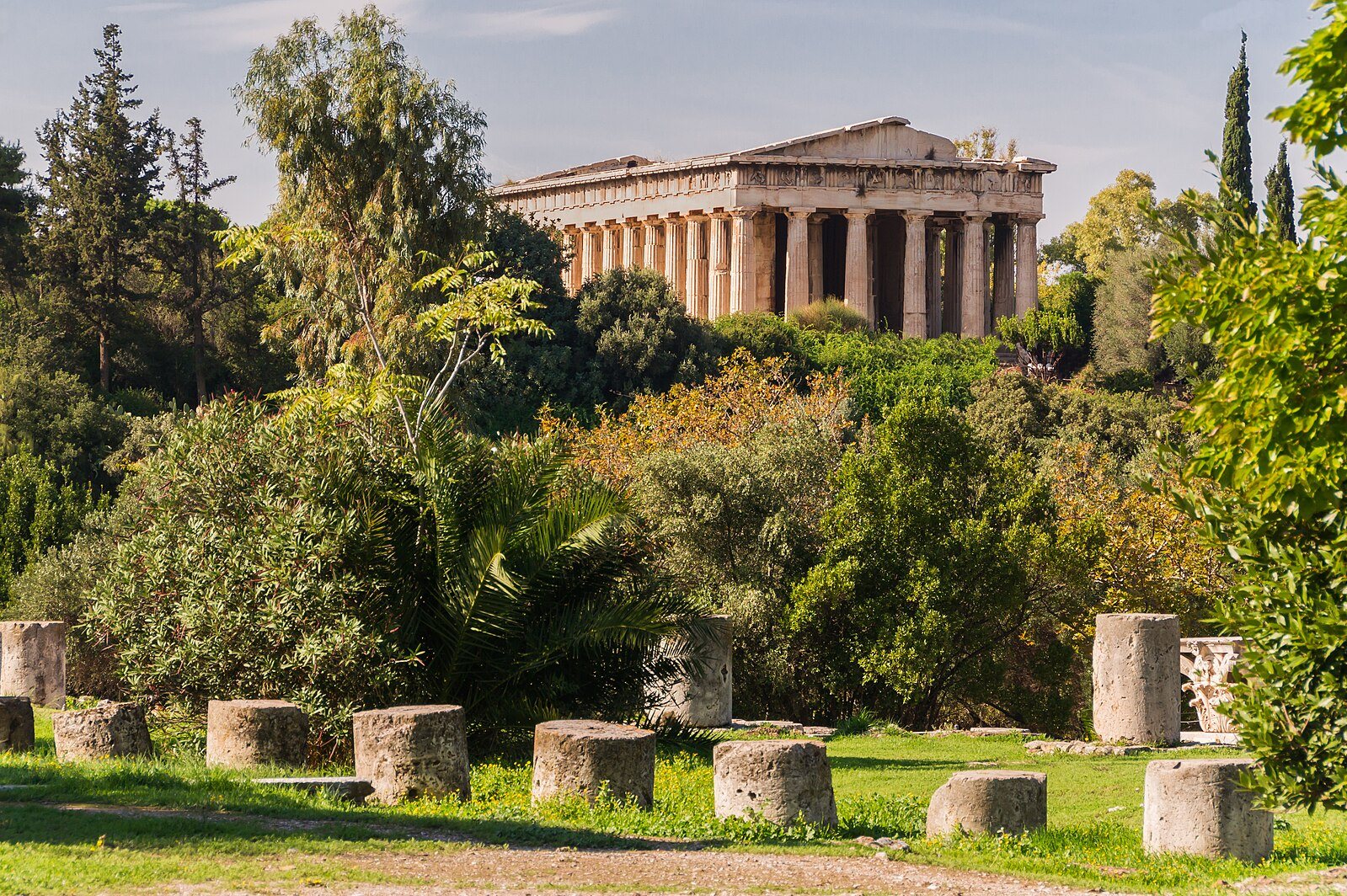
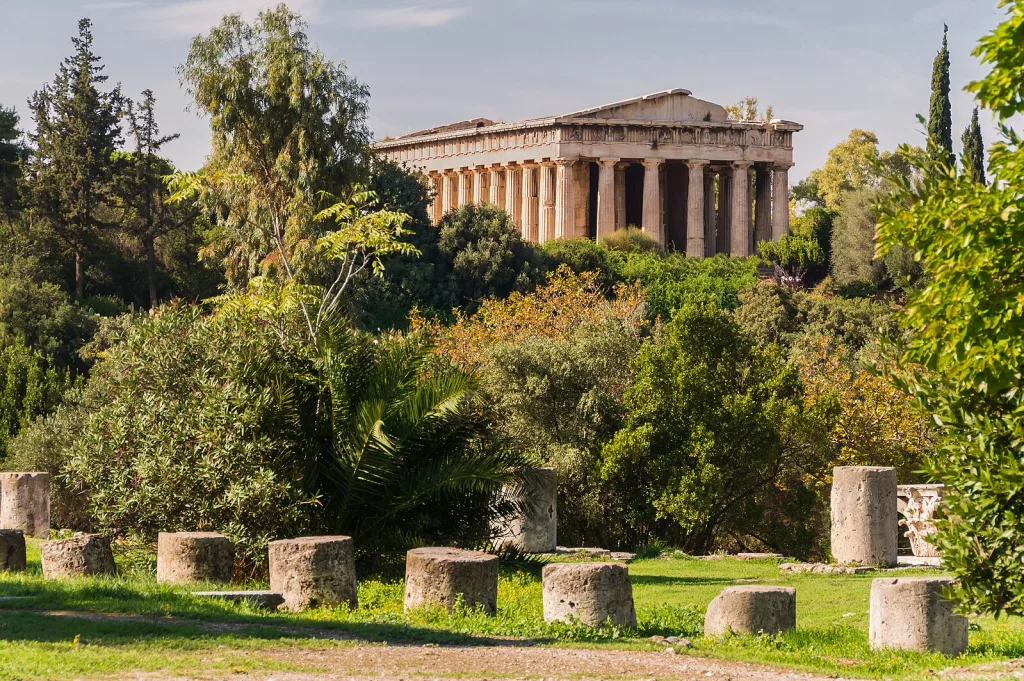
The Temple of Hephaestus stands on higher ground at the western side of the Agora, making it the clearest visual anchor for a first visit. From the permitted paths, compare its long colonnade with the shorter end, then look back across the excavation.
Spend time on the exterior rather than planning around interior access. The changing angle as you walk is part of the attraction: columns that appear evenly spaced from one viewpoint overlap and frame the city from another.
Read the Temple of Hephaestus guide
The council buildings: picture the work behind democracy
The remains of the Old and New Bouleuterion are less immediately dramatic than the temple, but they deserve a deliberate pause. Locate the council buildings on the plan and use their outlines to think about enclosed meeting spaces within the wider public area. Nearby, the Metroon brings record keeping into the same civic story.
Do not expect standing walls to do all the explaining here. A reference image or short audio stop can be especially useful before you look back down at the foundations.
The Tholos: the round building among the civic offices
The Tholos is easier to distinguish once you look specifically for its circular footprint. It served the council’s executive officials, including as a dining place, adding a domestic rhythm to the business of government. Its position near the council buildings is therefore more informative than its modest surviving height.
Compare the round plan with the adjacent rectangular structures. Then take a few steps back on the visitor path to see the group together. This compact cluster is a good place to understand that public administration required rooms for daily routines as well as formal debate.
The Eponymous Heroes: a public noticeboard in stone
The Monument of the Eponymous Heroes makes an abstract civic system surprisingly tangible. Its long base carried statues associated with the Athenian tribes, while the area was used for public announcements. Citizens had a practical reason to come here and read information relevant to them.
Look for the elongated pedestal and its surrounding fence arrangement rather than expecting a surviving row of heroic statues. Imagine the act of stopping to read, then turn toward the nearby civic buildings. The monument’s usefulness lies in that relationship between information, people and government.
Learn how public notices worked here
The Stoa of Attalos: recover the missing sense of enclosure
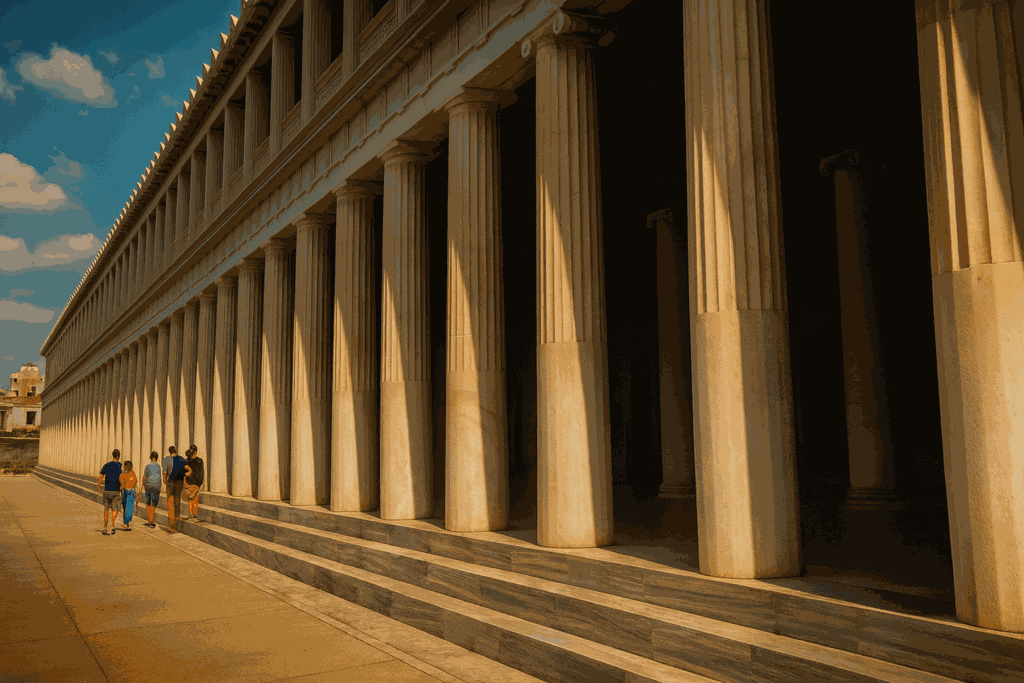
The reconstructed Stoa of Attalos makes the Agora’s built environment easier to imagine. Walk along the colonnade where access permits and notice the repeated bays, long perspective and change between sunlight and shade. The original building included shops; its architecture gave movement and trade an orderly frame.
Remember that you are seeing a modern reconstruction of an ancient building. That distinction makes it useful rather than disappointing: after so many low foundations, the stoa supplies a sense of height and shelter.
The Agora Museum: look for objects that explain civic life
Inside the stoa, the museum gives a closer scale to the buildings outside. Look for the displays about voting, public administration and daily activity, reading the labels to connect individual objects with practices you have just encountered in the excavation. A small object can explain a process more clearly than a large architectural ruin.
Choose a few exhibits to study instead of treating the museum as a quick indoor corridor. The strongest visit alternates between scales: a whole public space, a particular building, then something that a person could hold or use.
Plan a closer look inside the Stoa of Attalos
Plan a walk that includes the quieter foundations
Allow time for the temple, the civic cluster and the museum rather than walking directly between the two largest buildings. Check current admission and museum arrangements through the official visitor information before arrival. Footwear with grip is useful on the paths and the rise toward the temple.
Streetmodo’s Agora of Athens Audio Tour uses ten location checkpoints, including the Temple of Hephaestus, council buildings, Tholos and Stoa of Attalos. Prepare the app before entering and pause off the main path to listen. It is particularly helpful where little survives above ground. Admission to the archaeological site is separate from the app.
Sources and visitor information
- American School of Classical Studies · Athenian Agora excavations
- American School of Classical Studies · Agora site guides and research
- American School of Classical Studies · The civic center of the Agora
- Foundation of the Hellenic World · Eponymous Heroes monument
- Greek archaeological museums · Museum of Ancient Agora
- American School of Classical Studies · The Tholos and its predecessors
- American School of Classical Studies · Temple of Hephaestus research