 Streetmodo
How Did the Tower of the Winds in Athens Work?
At the Roman Agora in Athens, one small marble building records two things people crossing the market would want to know. What time is it, and which way is the wind blowing? The clues survive at different heights, so take a moment to examine a single wall from the roofline down.
Where is the Tower of the Winds in the Roman Agora?
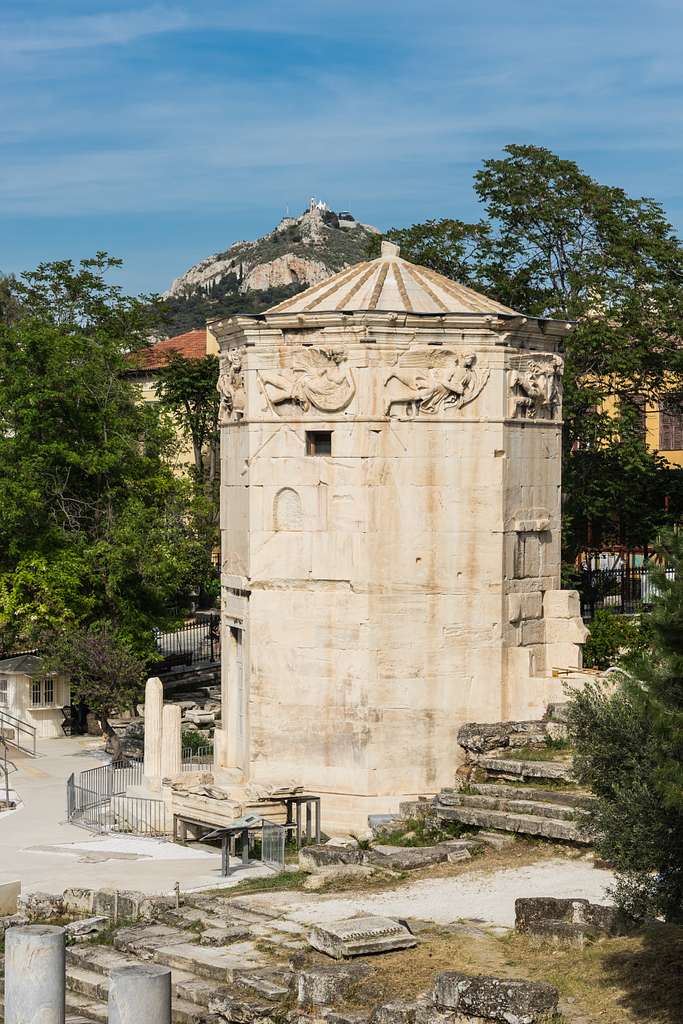
Use the Gate of Athena Archegetis as your landmark. This columned gateway marks the western entrance to the Roman market. Look across toward its eastern end for a compact tower with eight flat sides. From this distance its shape is easiest to see. As you approach, pick out the band of carved figures immediately below the roof.
Why does the tower have eight sides?
Each wall faces a different compass direction and carries a figure representing the wind from that direction. Boreas represents the north wind and Zephyrus the west. The ancient observer could look up to a rotating bronze figure of Triton on the roof. His staff pointed toward the carved wind that was blowing. The bronze vane is lost, but the ring of figures still shows how its directions were marked.
How did the tower tell time when there was no sunshine?
A water clock operated inside the tower and could measure time as water flowed. Outside, the walls carried sundials. Look below the wind figures for the cut lines that marked the passage of a shadow across the stone. Try following the marks around a corner. The next wall faces another part of the sky and would receive sunlight at a different time. The tower’s designer, Andronikos of Kyrrhos, fitted both ways of measuring a day into the same building.